9/21/10


Preppyism, that smart, collegiate and usually colourful attire, is one of the most enduring and yet one of the most vilified forms of dress. For though it finds back slaps, handshakes and approving bonhomie in the boardrooms of the bankers, the bars of the elite and the gin-palaces of the mighty, it is scorned and spited by the proles. Avril Lavigne, that kohl eyed poker-haired teen ‘rocker’, exemplified the ‘popular’ approach to preppyism in her song ‘Complicated’; “Laugh out when you strike a pose/Take off all your preppy clothes.”
Other popular culture has been no kinder to this manner of dress. In Igby Goes Down, Cruel Intentions, Wedding Crashers and just about any other film where the wealthy American elite are subjected to being a morally justified punching bag by the towering hypocrisy of Hollywood, preppy clothes are represented as the attire of evil, the SS uniform of today.
It is little surprise then that this hatred of prep has infected British culture too. The popcorn-munchers, nodding along to the subversive drivel onscreen, have clearly had their taste affected; a female friend of a friend asked me rather awkwardly why I dress as though I live on the Upper East Side; “Have you been inspired by Chuck Bass?” she asked pityingly. Although I informed her rather dismissively that I was wearing bow ties before Bass was even a scribble on a storyboard, I noted a tinge of disapproval too. Preppyism is apparently the act of appearing wealthy; at its baser end it means the donning of labels and logos – particularly Ralph Lauren – and at the more sophisticated end, the sort of styling that belongs at a mid-20th century Ivy League college. Either way, detractors state that it is an affectation to appear wealthier than one is.
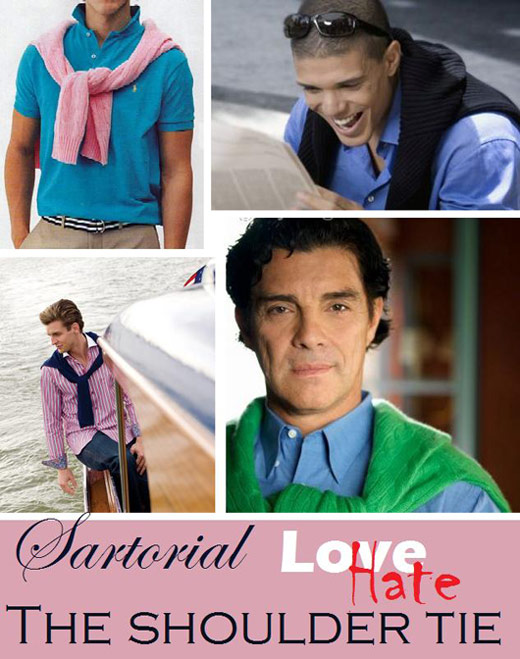
One of the flying standards of preppyism is the classic, and often pilloried, jumper-tied-around-the-shoulders. This affectation is one of the trademarks of the preppy look and its deployment causes ridicule as well as raucous WASPish applause. Practically, it makes sense. It may well be too warm for a jumper in the afternoon but by the time twilight sets in, a chill could descend. It is difficult therefore for anyone to begrudge the use of a jumper. However, is a gentleman justified in wearing it tied over his shoulders rather than anywhere else on his body? Couldn’t he just carry it with him, or fold it in a bag?
Firstly, let us consider the other popular options. He could wear it tied around his waist although this is inelegant and impractical; the kilt-ish jumper would get creased and crumpled from being sat on, not to mention the possibility of attracting dirt and grime. Also the associations of this practice (football hooligans, louts) are far worse than anything the shoulder-tie could muster. It could of course be carried, although this would leave only one hand free; not a happy situation when two hands are required. It could be carried in a separate bag although this would only be convenient if the bag was required for some other purpose.
The problem people have is not with the practicality but the image it conveys; if not a ‘detestable’ member of the upper-echelons, a poor parvenu. It looks pretentious in certain contexts and, rather unfortunately, is a habit that has been adopted, at least in my own circles, by some of the more snobbish and vindictive of people. There is certainly an exaggeration and caricature of the practice and it is arguable that Hollywood’s representation of ‘evil snobs’ in the attire would necessarily attract those who consider it a badge of honour to be such a character. However, each man has his own experience of the shoulder-tie – I have no especial dislike of the practice, and have found my own shoulders useful on a changeable summer’s day – but there are those who avoid it, lest they should be associated with the ‘set’ which flaunts the ‘uniform.’
The duty of wearing black tie is avoiding individualism; refinement is permitted, adornment ill-advised. Most men are not interested in adornment, so the act of wearing what every other man is wearing is actually rather comforting to the majority. As fussy and funny as the ‘t-shirt and shorts’ man might think black tie, when he sees everyone else is so attired, he relaxes into the evening, safe in the knowledge that the oddity he frowned upon in the mirror is not alone.
Other men, the ones who relish black tie, often find it rather frustrating that they have such little room for experimentation. Custom warns against ‘peacocking’ and so they find themselves, however more elegantly cut, in the same attire as every other Tom, Dick and Harry; wool dinner suit, white cotton shirt, black silk bow. A rogue pocket square is a temptation, but so often regretted and though buttonholes are an addition frequently neglected by the majority, many well-dressed men are still reluctant to employ them. One friend ‘dissed’ my red carnation and informed me that a modern James Bond “would never wear a flower.”
The choices for subtle individuality are slim. A stiff shirt with a detachable stiff collar is certainly an option but it’s bothersome and takes practice and patience. A creamy white jacket isn’t as smart or as practical as black or midnight blue, and many consider it ‘out of context’ if deployed away from Glyndebourne or the Riviera. Waistcoats are useful, but a no-go in the warmer months and they are increasing in popularity, threatening their status as a choice for the ‘individualist.’ I think both patent Oxfords and pumps are wonderful; still surprisingly rare and very elegant. However, many graceful and frustrated gentleman already own a pair or two and are seeking something different, something more unusual which will mark them as a man of thought and subtlety.
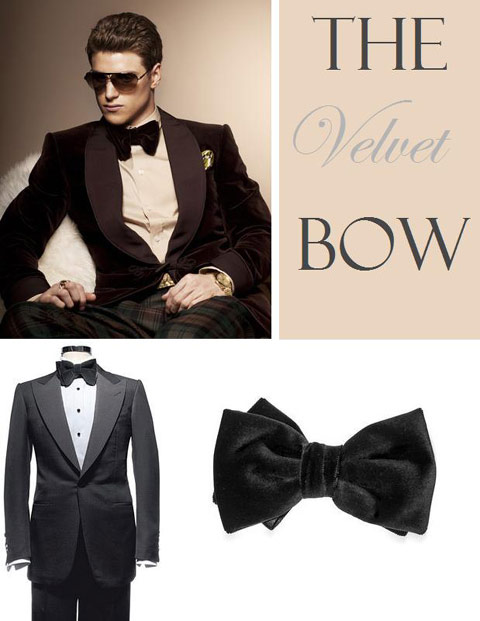
Bring forth the velvet bow tie. Shocking? No. Brave? No. Unusual? Certainly; however ordinary the idea of a velvet bow tie seems, you would be hard pushed to find another at the same event. It has a mildly foppish quality, something between Austin Powers and David Niven, and it offers an alternative texture and structure to silk, contrasting perfectly with one’s lapels. It’s also ever so slightly naughty; the velvet bow tie man is certainly not a ‘stiff in a suit.’ There is a faint and attractive hint of scandal about him; he has seen things, done things – but of those things, no one dares speak. He might be tempted to pair his bow with a ‘waterfall’ pocket-square but this would hamper his underlying masculinity; a simple puff of creamy silk will suffice.
The hell of it is, the self-tie velvet bow, the answer to the ‘subtle individualist’s’ black tie prayers is, rather fittingly, a devil to find.
In my recent article on the velvet bow tie, I wrote of the antipathy of an acquaintance towards what Wilde famously referred to as the “only link between Art and Nature” - the buttonhole. What was once worn by all who could afford it is now merely an eccentric habit of a tiny few; spotting buttonholed gentleman on the streets should become a sport, so needle-like are these men in the haystacks of society. It is partly because of this paucity of posies that gentlemen are reticent to adorn themselves with something so feminine. Fashion has proven that it can play its part in sartorial arm-twisting; pink shirts and pocket squares are testament to this, so I have no doubt that should future runways be awash with carnations, the trickle-down effect will see large scale adoption.
However, there will be those to whom wearing a flower on a daily or even weekly basis is but an inconvenient expense. And the inconvenience can be considerable. You’ll be pointed at, asked “where the wedding is” and possibly insulted by passing white-van men with taunts of “Poofy bastard!” and “Big girl’s blouse!” Some are resilient and sufficiently single-minded to ignore such slings and arrows. But, as Noel Coward might once have sung: “Others will consider them simply too unpleasant to bear, however much they privately approve of ‘la boutonniere.’”
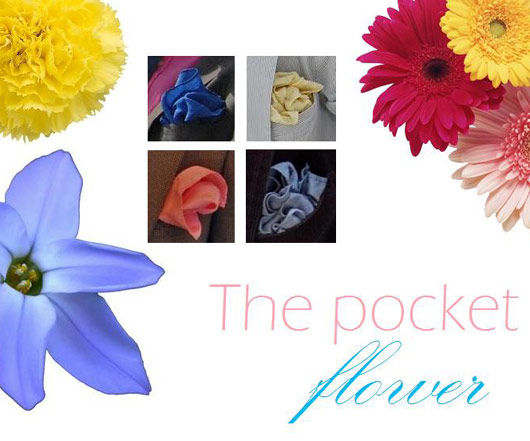
The solution for the flower-fearful is to adopt some kind of floral substitute, one which is attractive but less conspicuous. The aforementioned pocket square, that most useless of useful adornments, is common enough but it is normally worn very plainly and timidly. Many wearers only allow the merest hint of folded cotton; a tiny rectangular star in the dark galaxy, the TV fold is the style for beginners. Others are fond of the single point or, as I call it, the ‘napkin’ – a slightly more adventurous triangular mountain peak whilst some have moved on to the 3 and four pointed folds. The more slapdash and artistic ‘pocket stuff’, basically a more careless and full-blooded version of the reverse ‘pouf’, is becoming more popular as pocket square veterans seek to differentiate themselves from the masses and this style is even beginning to spawn its own variations. The ‘pocket flower’ is my favourite of the ‘stuffs’ and it is so deliciously simple to create.
Imagine, if you will, the layered petals of a bloom. Hold the centre of your square in your hand and close your fingers together; you will see the ends tightening up against each other, replicating an open flower. Stuff this into your pocket, allow for plenty of unruly shape, and you have the effect of wrinkled petals. It works best with silk, particularly in popular floral colours like pink, pale yellow and deep red and those with contrast-colour edges, and needs well-rolled edges and an extra large surface area to generate the ‘puff’ required.
The waistcoat renaissance was rather rashly dismissed a few years ago as a passing trend. As with other trends, critics opined ‘that for which there is little need, there will be little life.’ Men’s clothing is different to women’s clothing in this regard. Women’s trends can be unpredictable, their longevity irregular. Handbags are never needed but simply ‘wanted’; the glum male faces in the mighty emporia of feminine clothing betray not simply their boredom but their disapproval: “I’ve only got one briefcase, why do you have to have six purses?” This is the modern man. And this is why so many wag fingers of knowing correction when someone talks of the new ‘thing’ in male fashion. For the probability is that unless this ‘thing’ is of substantial ‘use’ it will not maintain the attention of sufficient a number of men.
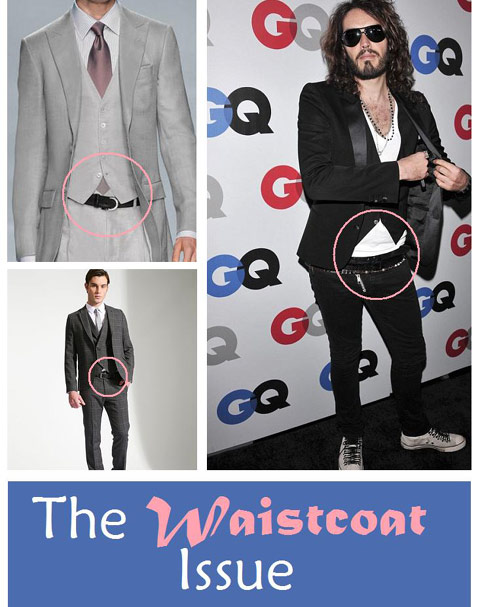
Two things happened which destroyed the cynical opinion that waistcoats were another vain attempt to project a more elegant sartorial past onto the modern man; firstly waistcoats were rediscovered as a ‘useful’ item of clothing and, secondly, men began to rediscover their inner dandies. A little ‘want’ was creeping into the masculine mentality. Few people point and stare and the waistcoat now; it has lost that conspicuous ceremonious quality through its intensity and spread of recent use. All this I approve of. The ‘elegantisation’ of the general is a much desired thing. However, I do (unfortunately) have one concern with the way it is worn.
Instead of wearing their trousers on their waist, many men wear their trousers like their jeans – on their hips. At school, the trend was the same. Trousers bought to be worn higher up were pushed down to avoid sniggering, pointing and, in some cases, outright bullying. Years and years of the Italian suit trend, exemplified by Armani, saw trousers being worn lower. Considering this with the popularity of low-slung American-casual clothing, is it any surprise that the vast majority of high-street suit trousers today are made to be worn on one’s hips? Sadly, when you throw this in the style-blender with the waistcoat, the result is unfortunate. Instead of covering the top of the trousers, the waistcoat finishes above the trousers with an unattractive stretch of shirt poking through. While it might be acceptable for Russell Brand’s peculiar ‘brand’ of style, it isn’t really appropriate for suit attire.
It is important to maintain space in the crotch and seat of the trousers, so a lot of modern variants that offer less forgiveness in this region will not be able to be yanked up to the waist without considerable pain and discomfort. The key is to avoid trousers that are constructed like denim and go instead for trousers that can be worn nearer the waist.The waistcoat will then cover the unsightly folds of shirt and the unattractive belt-loops of the trousers. Any ‘position maintenance’ should really be achieved with braces and not belts.
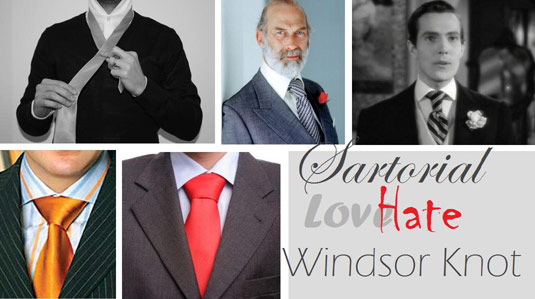
One of the most interesting comments I receive about my clothing is that for such an ostentatious person, my tie knot is perplexingly small. Puffs of silk; colour matching and contrasting; texture complementing and yet such a tiny knot. “I thought” new acquaintances often mumble “you’d wear a big Windsor knot.”
I used to be a fan of the Windsor. Whilst at school, I trained myself to tie the perfect version and was very conscious at social functions about my knot and the knots of others. It made sense that I should be so faithful, for I was a speedy devotee of the cutaway collar which, because of its wide spread, is considered to be more befitting of an enormous Windsor ‘doughknot.’ I was eventually turned against the alarming size by reviewing photographs of myself, an emaciated youth, with a thin neck and a fat knot; it was an unattractive contradiction that made the tie look heavy and simplistic. I surfed around for a style that I did not find so visually revolting and settled on the four-in-hand which I now tie, like my father, into a smallish knot.
The Windsor is no worse for my rejection of it; it is simply everywhere. Perhaps it is the name, the royal connection or the popularity of cutaway collars but it seems the Windsor knot has never been more popular. I trawled through Lewin’s sale selection recently and my companion was shocked at my approval of the new St James collar, the most extreme cutaway Lewin has produced to date, and, mystified, asked me “Don’t you have to wear an enormous knot?” I was equally confounded; “What on earth for?” He replied earnestly “You know? To fill the space? Otherwise you see the bits either side.”
If you tie a tie properly and wear the right collar size, you shouldn’t see ‘the bits’ either side of any knot. Prince Charles, for example, is fond of smaller knots and wider collars and manages to tie a tie without any ‘bit’ exposure. Firstly, he knows that the tie should be secured to the top rather than the middle or bottom of a collar, and that the ‘bits’ are correspondingly squeezed into the crevasse under the ridge of the collar. I choose this style because I believe that it averts attention from that area; the Windsor, so noticeable in size, attracts attention and this means I spend a great deal of time looking at people’s chins which is not a pleasant pastime.
However there are those who wish to attract attention to their neckwear and to remove the ‘presentation’ from their silk is simply not an option; the Windsor is a presentation knot, one for men of confidence and self-consciousness. These men do not wish to be seen to be strangled in an attempt to convey subtlety. They believe in proportion and it confuses them that others can be so generous in tie width and yet so mean in tie knot.
The Windsor is frequently cited as the most comfortable of knots, remaining tightly tied whilst still allowing ‘breathing room’ between the collar and neck. For me this is it’s main benefit, and I do concede that certain people, for example Prince Michael of Kent, wear it very well but those who experiment with it tend to overegg it rather which results in something that looks less like a cravat of royalty and more like an attempt of a sartorially illiterate footballer. I think the key is to follow the aesthetic of Hurd Hatfield and HRH in the pictures above (top right); make the knot more conical than triangular (see bottom left) – and do not flatten the wretched thing (bottom centre).
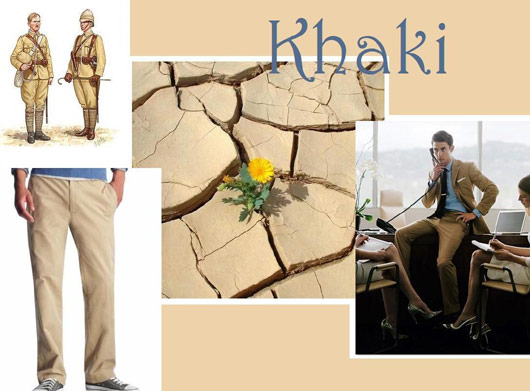
Khaki was never manufactured to stand out. It comes from an Indian word meaning “dust coloured”; fabrics in this shade were first produced as camouflage for the British Indian Army regiments by a British textile firm in the 1870s. The colour of light clay, the Brits found that khaki was extraordinarily useful and variations on the colour and the textile it was dyed on still exist in the forces today. Khaki drill played its part in the Boer War, the Spanish American war and both World Wars and is usually the first thing anyone thinks of when you utter the words ‘El Alamein.’
It is perhaps appropriate that khaki is considered to be the first ‘practical’ colouring for the modern army. When it was used in southern Africa, the Zulu wars that had ended a decade before had seen scarlet tunics with brass buttons and Pickelhaube style white pith helmets with gold chinchains and shining capstars – acceptable for the Battlefield of Waterloo but completely outdated in world of modern warfare. Blending into the background had become not only a strategy but a priority.
Suitably, the modern ‘khaki’ trouser is the premier choice for the gentleman ill-inclined to fuss or show-off with his clothing. As the Tommies in Tobruk were indistinguishable from the landscape, so is the weekend shopper at Wal Mart. While it bounces in and out of trend, it never scoops up much attention. The man who shies away from the world rests his eyes on a pair happily as he traverses the terrifyingly open terrain of the local clothing store. Where casual clothing is concerned, khaki is always a safe choice, a refuge; social camouflage.
However, khaki trousers should be the start, and not the end, of an ensemble. Popularly paired with white or blue polo shirts and white trainers (eurgh), khaki trousers are capable of a great deal more; pink shirts, blue blazers, suede shoes, the list is endless.
The other problem is that they are commonly worn baggily and saggily, weighed down by wallets, coins, phones and small guide books; no matter what a man wears, denim or Dormeuil, he should always strive to maintain a good silhouette.
And while they are certainly appropriate for casual wear, they are not unheard of at formal functions; I remember an American gentleman at a summer wedding I once attended, quite the most elegant man there, in a navy blazer, blue end-on-end shirt, Madras bow tie, spectators and khaki chinos. The bow tie and blazer were a nod to formality, the spectators added the fun and the khakis added a cool, contrasting masculinity.
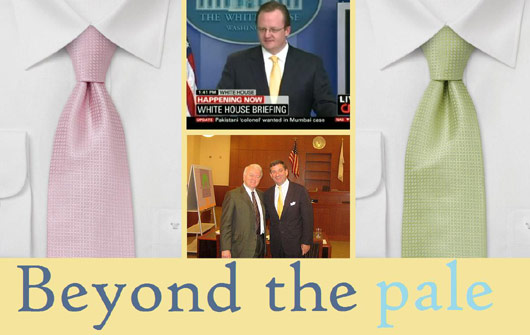
A gentleman wakes on an average, overcast morning. He performs his toilet, selects a suit from his wardrobe and flicks through his shirts for a suitable choice. White is the colour of choice for our hypothetical gentleman, simply because it is the default of the masses; were he to select a French collared check shirt, he would have no relevance to the majority. Then he sets about choosing a tie. He opts for a pale yellow plain weave silk, completes a Windsor knot and then turns from his mirror toward the door.
What is wrong with this? Well, not a lot. Something which the masses would echo, en masse I have no doubt. However, when he catches a reflection of himself in a shop window on his way to the office, he notices something rather peculiar; he doesn’t appear to be wearing a tie at all.
His tie is so pale, that from a distance, and in low light, it simply merges with the white; this contrasts sharply with the darkness of his charcoal suit (again, the choice of the masses) and creates a rather odd separation of the ensemble; the suit and the shirt and tie are not in concert, indeed they are not even in the same society. This, I have noticed, is a common problem.
As a style touch, when shopping for neckwear a man should always know there is life beyond the pale.
Darken your tie
If a white shirt must be worn, darker ties will always look smarter than paler ties because they are more restrained, more ‘Monday morning.’ It is possible to pick up some very attractive and discreetly patterned darker ties that flatter not only the white shirt, but the charcoal suit it is worn with; the ensemble appears connected, sober and mature.
A little pattern
When wearing a plain shirt, a little pattern goes a long way as far as neckwear is concerned; don’t follow the politicians with their PR-friendly Lego ties, go for a polka dot, a club stripe, or a foulard.
Go shirt shopping
There is nothing wrong with pale ties. They are certainly brasher than darker ties, so you must be careful where and when you wear them but also, what shirt and suit you wear them with. A cornflower blue is a better companion for a yellow or a pink tie than a white, so stock up on some saturated shirts.
A warning about matching
Resist the urge to match the pocket square to the pale tie. This creates a ‘modern morning dress’ effect and destroys the seriousness of an ensemble; not ideal for client meetings where dignified concern is required. The tie shouts loudly enough on its own. Lower the volume by selecting a more subtle square.
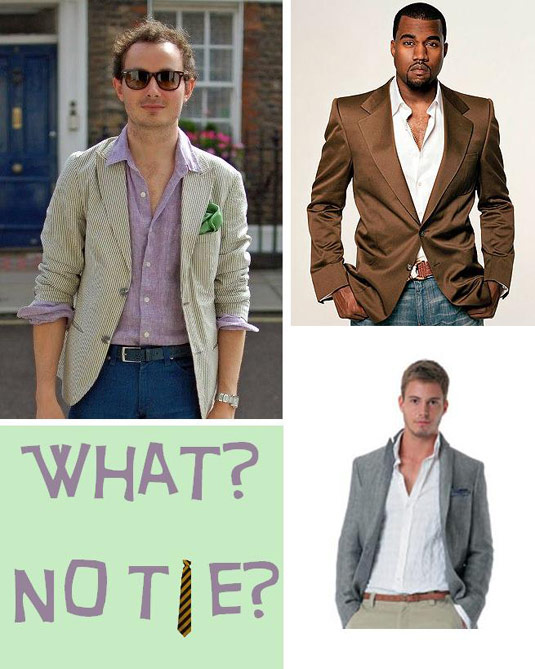
Wearing a tie out of choice can provoke some interesting commentary. People tend to nod approvingly, make pleasant-but-commonplace remarks about smartness and pay the neckwear more attention than it deserves, but importantly they place so much consequence on its appearance in an environment in which it is entirely unnecessary, much as an open neck wing-collar would attract attention at a Viennese ball, that they chain you to your choice from the very beginning: “I haven’t ever seen Winston without a tie” they beam, as though contemplating some natural wonder “You’d always wear a tie, right? I mean, you must wear a tie?”
Well, no. I don’t wake each bright morning thinking that the attachment of neckwear to my collar is of the highest importance. Nor do I wear one as a rebellious nose-thumbing to the dying popularity of the accessory; men who believe in ‘standards’ without an appreciation of the aesthetics are no allies of mine. The answer is simple; I wear one because I feel like it. I feel like adding that dash of colour, that swirl of silk to an otherwise lifeless ensemble. That I feel like doing that nine days out of ten is merely a reflection of the fact that I am fortunate, and sufficiently confident, to be able to do what I like doing.
When I don’t wear a tie, it is also a choice; my tie wardrobe is not on strike, my house has not burned down and I have not sold off my cherished strips of silk as I feel a “change coming on.” I am still resolutely a tie man; calling it a “day off” is pejorative as it suggests my daily tying routine is a chore, but it is a pleasant enough change. The question is; how does my appreciation for aesthetics and colour, my preference for maximalism sit with such a choice? In other words, how do I not wear my ties?
No suit, no tie
Ties tend to be associated with the workplace. Many a gentleman have cherished that soothing moment of release when he returns from the office, removes his shoes and unties his tie. Recently, some men have contradicted the formality of a suit by removing the tie and unbuttoning an additional button, a la Tom Ford and Simon Cowell. Personally, I don’t see that this ‘look’ works; the tie is expected, and it isn’t there. It doesn’t look like you never put a tie on, it looks like you have just taken one off; a state of ‘undress’, rather than of ‘dress.’ If I am pulling a suit from the wardrobe, a tie is always coming with it.
Let your pocket square be your tie
Going tieless is the perfect opportunity for grandiose pocket squares. Whether brightly coloured or prettily patterned, they have a golden opportunity to shine in the absence of neckwear. Dashes of colour add spice and interest to otherwise commonplace outfits and when a tie is not selected to perform that function, the noble pocket square steps up.
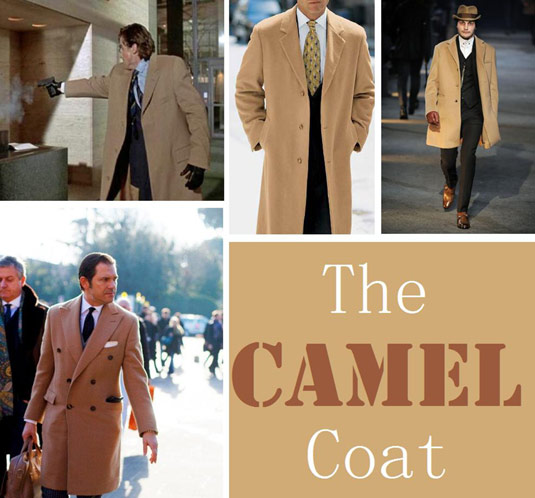
I wandered into Zara recently to have a mooch around. It’s not a store in which I seek inspiration but for some reason, inspiration seems to creep up and bang me on the head rather often. Exactly two years ago, while on holiday, I purchased a charming check coat from the Lisbon branch. Exactly a year later, my eye was caught by a rather splendid deep blue coat and the other day, not expecting to see anything of interest, I winced – in the knowledge that I would soon be a trifle poorer – when I saw a rather attractive double breasted camel coat. Whether I bought the Zara model or settled on another, I knew I had found the overcoat for 2010.
I had never considered a camel coat before. I have always thought myself a little fair-skinned to wear such a colour, particularly in the depths of winter when my pallor is at it’s most shockingly colourless. My first counterargument when I tried the coat on and admired it’s shape, size and surprisingly flattering colour was that I still had the remnants of a summer tan, that my hair was flatteringly sun kissed and that by the time the season had arrived for wearing such a garment, my tan would have disappeared and my hair returned to it’s anonymous mousiness.
Fit
Fit is always important but with a darker coat, you can get away with little imperfections. Camel coats do not allow such imperfections to go unnoticed because the eye is drawn to them; a little too much width or length and the effect is disastrous. This is certainly a coat you can buy off the rack but it’s a very good idea to ask a tailor to check the fit for you and make any adjustment suggestions before it’s first outing.
Style
Zara’s model was double-breasted which, when buttoned, was sharp but unbuttoned looked rather ‘flappy.’ Unless you are having one made or adjusted, open double-breasted overcoats can look rather ungainly. If you tend towards open rather than buttoned overcoats, pick a single breasted version. Be careful with the length – an overly long camel coat, no matter how well tailored, looks trampish. Maximum length should be just below the knee. A note on minimum length, English chaps should avoid the shorter Del Boy style; unless you have a seriously impressive 1970s wardrobe to partner it with, it won’t work.
Wear it with…
Cornflower blue shirts, blue suits, blue denim – camel is a perfect companion for all things azure. White is also a happy, if less inspiring, complement. Don’t just wear it at the weekends either; Christian Bale’s Patrick Bateman (above) provides one of his more convincing arguments for wearing it on the daily trundle to the metropolitan office.


